
Quarter-End Compliance Checklist for Businesses | GST & TDS
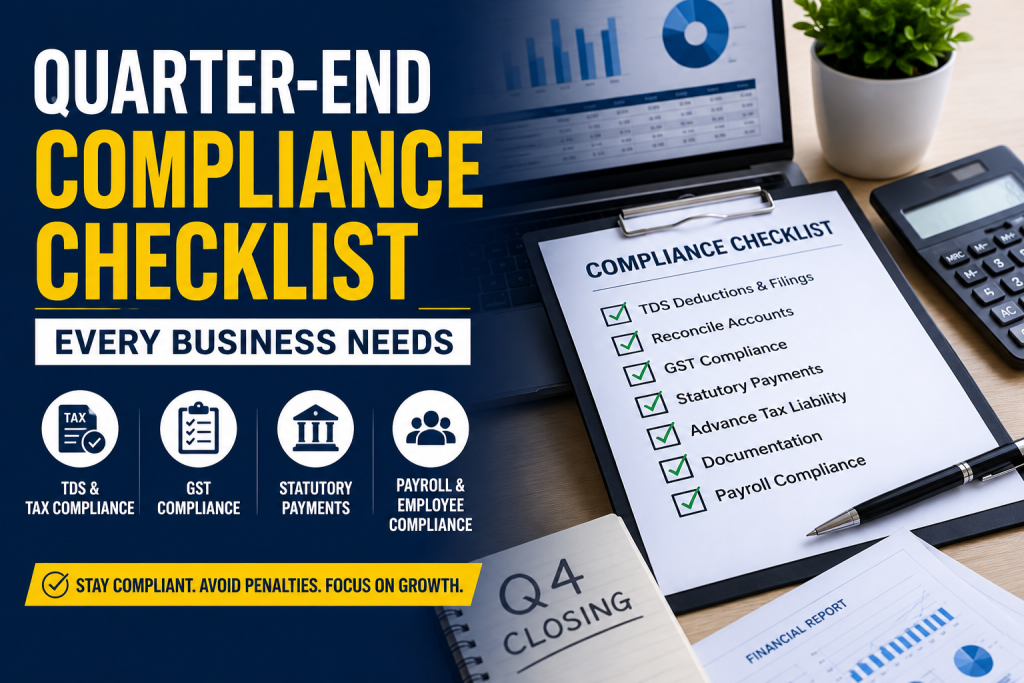
Quarter-end is not just about closing books—it’s about ensuring your business stays compliant, penalty-free, and audit-ready. Whether you’re a growing startup or an established enterprise, missing even a small compliance task can lead to financial and legal complications. A structured checklist can significantly impact the difference between a smooth close and last-minute chaos. Here’s a practical quarter-end compliance checklist every business should follow to stay on track. 1. Review TDS Deductions and Filings Start by verifying all Tax Deducted at Source (TDS) entries for the quarter. Ensure that: Once verified, proceed with timely return filing. Delays or errors can lead to penalties and notices, so accuracy is critical. 2. Reconcile Books of Accounts Reconciliation is essential to maintain financial accuracy. Compare your: Identify mismatches and resolve them before the quarter ends. This helps avoid discrepancies during audits and ensures reliable financial reporting. 3. GST Compliance Check Ensure all GST-related activities are completed: Incorrect GST filings can lead to blocked credits and compliance risks, so cross-checking is a must. 4. Verify Statutory Payments Confirm that all statutory dues are paid on time, including: Late payments attract interest and penalties, impacting your business financially and legally. 5. Check Advance Tax Liability Evaluate your business income and calculate any advance tax payable. Paying advance tax on time helps avoid interest under applicable tax provisions. It also ensures better cash flow planning for the business. 6. Documentation and Record Keeping Organize all financial documents for the quarter, such as: Maintaining proper documentation ensures smooth audits and quick responses to any notices from authorities. 7. Payroll and Employee Compliance Review payroll records and ensure: Employee-related compliance is often overlooked but plays a key role in overall financial accuracy. Conclusion Quarter-end compliance doesn’t have to be stressful if approached systematically. With a clear checklist and timely action, businesses can avoid penalties, maintain accuracy, and stay fully compliant. More importantly, it allows teams to focus on growth rather than firefighting compliance issues. Adopting the right tools and processes can further simplify this journey, making compliance not just a requirement—but a competitive advantage.
Advance Tax Calculation FY 2025-26 (AY 2026-27) – Key Pointers
Introduction Advance tax is a cornerstone of income tax compliance in India. Instead of paying the entire tax liability at the end of the year, taxpayers discharge their dues in instalments as income accrues. This “pay-as-you-earn” approach prevents a sudden burden at year-end and ensures steady revenue for the government. For FY 2025-26 (AY 2026-27), advance tax assumes added significance due to revised slab rates and an enhanced rebate limit. Whether you are salaried, self-employed, or running a business, understanding these updates is essential to avoid interest under Sections 234B and 234C and to manage cash flows smoothly. 🔑 AY 2026-27 – What’s New? 1. Revised Slabs under Section 115BAC The new regime slabs have been reshaped as follows: Income Range Tax Rate 0 – 4 Lakhs Nil 4 – 8 Lakhs 5% 8 – 12 Lakhs 10% 12 – 16 Lakhs 15% 16 – 20 Lakhs 20% 20 – 24 Lakhs 25% Above 24 Lakhs 30% 2. Higher Rebate under Section 87A The rebate limit has been lifted from ₹7,00,000 to ₹12,00,000. This means taxpayers with income up to ₹12 lakh (excluding special-rate incomes like capital gains) will have zero tax liability. Marginal relief applies for those slightly above the threshold. 📌 Points to Keep in Mind While Paying Advance Tax ⚙️ Practical Tips for Compliance ✅ Conclusion Advance tax is more than a statutory requirement — it’s a financial discipline that spreads liability across the year. For FY 2025-26 (AY 2026-27), taxpayers must pay close attention to new slab rates, enhanced rebate limits, revised thresholds, and MAT/surcharge provisions. By carefully estimating income, accounting for salary from multiple employers, considering capital gains, validating housing loan deductions, and applying the right surcharge/MAT rules, you can avoid penalties and interest. Timely advance tax payments not only ensure compliance but also reflect sound financial planning.
Still Confused About TDS? Here’s What You Actually Need to Know

Tax Deducted at Source (TDS) is one of those financial terms everyone has heard of—but not everyone fully understands. Whether you’re a business owner, freelancer, or salaried professional, TDS plays a crucial role in your financial ecosystem. Yet, confusion around it often leads to errors, delays, and unnecessary stress. What Exactly Is TDS? TDS is a system where tax is deducted at the time of making certain payments—like salaries, rent, professional fees, or contractor payments. Instead of paying tax in one go at the end of the year, a portion is collected in advance by the payer and deposited with the government. In simple terms, it’s “pay as you earn” in action. Who is responsible? If you’re making specified payments, the responsibility to deduct TDS lies with you. This means businesses, firms, and even individuals (in certain cases) must: On the other side, the recipient can claim this deducted amount while filing their income tax return. Why Does TDS Create So Much Confusion? TDS isn’t complicated by design—but the details make it tricky. Different types of payments have different rates, rules, and thresholds. Missing even a small detail—like applying the wrong rate or entering incorrect PAN information—can create compliance issues. Some common areas of confusion include: This confusion often leads to last-minute rushes and avoidable mistakes. What Happens If You Get It Wrong? TDS errors can have direct financial and legal implications. These may include: Even small errors, if repeated, can build into bigger compliance challenges over time. How to Make TDS Simple and Stress-Free The key to handling TDS efficiently lies in consistency and accuracy. Keeping your financial data organized, tracking payments properly, and staying updated with applicable rates can go a long way. More importantly, having a structured system—whether manual or digital—helps reduce dependency on last-minute fixes. Regular checks, proper documentation, and timely action can turn TDS from a headache into a manageable routine. Conclusion TDS is not just a tax requirement—it’s a responsibility that ensures smooth financial operations and compliance. Once you understand the basics and build the right process around it, it becomes far less intimidating. Clarity leads to control—and when it comes to TDS, that makes all the difference.
Effortless GST Filing Software: Next-Gen Automation for Faster Compliance

Imagine GST filing makes you feel like running in a maze with last-minute errors, a number of invoices, and reconciliations. For business and financial professionals, these can be stressful, tedious, and error-prone. In this volatile tax management ecosystem, businesses require more than just software, which includes efficiency, precision, and advanced automation. And that’s where Sinewave comes into the picture, powered by next-gen automation, marking every step simpler, faster, and effortless. Sinewave not only eases the process but also provides accuracy and compliance. Here’s how Sinewave redefines GST compliance. Real-time data sync: Always ahead with every update Real-time data sync ensures that every entry, update, and transaction stays aligned with the tax and accounting domains, making it one of the most powerful advantages of Sinewave. Rather than manual uploads, Sinewave automatically captures changes and provides instant visibility, accurate calculations, and compliance readiness. Synchronisation of real-time data reduces delay, removes discrepancies, and makes the entire workflow run smoothly. With real-time data sync, mismatches can be avoided and compliance can be ensured at every step. Instant error spot with smart validation When you go manually for GST filing, it often leaves room for mistakes. These mistakes can be duplicate invoices, unclassified transactions, or ineligible ITC claims. To tackle these issues, Sinewave provides seamless error detection with smart validation. When the data is uploaded, the GST filing software scans every aspect of it in real-time and flags discrepancies. Other than error detection, the software does suggest the required changes. The internal automated software audits don’t just offer error-free data, but also enable businesses and professionals to submit accurate GST returns. GST Filing – with just one click GST Filing – sometimes become a very tricky thing to do. Just one click and you have submitted your GST with Sinewave GST filing software. The software is integrated with the GST portal, ensuring seamless, error-free upload without any manual entries, making it hassle-free. These seamless steps reduce the risk of any errors and rejections. Cloud-based – safe and accessible data from anywhere, anytimeTo make sure your data is secure, backed up, and accessible all the time, Sinewave offers you cloud-based GST filing software. With advanced encryption and robust security protocols, Sinewave keeps your financial information safe & secure, also ensuring real-time updates. The data can be accessed from anywhere and anytime due to its cloud-based feature. No more worry about lost files or manual backups, Sinewave has your back with reliable, scalable, and accessible solutions. With smart compliance alerts, never miss a deadline With ever-changing GST deadlines, Sinewave GST Filing Software keeps you updated with a smart compliance alert system. The alert system keeps you informed about the GST deadlines and ensures to sends you notifications in real-time. These automated reminders help businesses and tax professionals stay active, eliminating the risks of various factors, such as late submissions and penalties. With seamless compliance, Sinewave never lets you miss deadlines and helps you focus more on business. With Sinewave’s Taxbse GSTPro, GST filing is no longer a stressful and time–consuming task. With accurate, streamlined, and hassle-free compliance, businesses and tax professionals can be more focused on their work, saving their time. The GST Filing software is itself designed to simplify the workflow. With more than 30,000 trusted clients, Sinewave stands out in its computer services product. FAQs Q: What if the GST return is not filed for 6 months? A: If the GST return is not filed for 6 months, then it will lead to cancellation. Q: What are the most common errors during the GST filing?A: The most common errors during the GST filing are late filing, mismatched PAN number, etc. Q: What is the minimum turnover for GST return filing? A: The minimum turnover for GST return filing is INR 40 Lakh. Q: What is the penalty for wrong GST filing?A: There is no penalty for wrong GST filing under the GST Act. Q: What is the full form of GST?A: GST stand for Goods and Services Tax. [/et_pb_text][/et_pb_column][/et_pb_row][/et_pb_section]
Reporting Foreign Assets and Income in India- Disclosures in ITR
Introduction With globalization, many taxpayers in India hold assets or earn income outside the country. To ensure tax transparency and prevent tax evasion, India participates in international information-sharing systems such as the Common Reporting Standard (CRS) and the Foreign Account Tax Compliance Act (FATCA). Through these systems, the Income Tax Department automatically receives details of financial accounts held by Indian residents abroad. Because of this, full and accurate disclosure of foreign assets and income in the Income Tax Return (ITR) has become extremely important. Non-reporting can lead to penalties under Indian tax laws, including the Black Money Act. — ⭐ Crux: What Information Does India Receive? Under CRS and FATCA, India receives detailed information about overseas accounts held by Indian residents, which may include: · Account holder’s name, address, nationality · Tax Identification Number (PAN/TIN) · Account number and type · Account balance and peak financial value · Payments such as interest, dividends, proceeds from sale/redemption · Details of controlling persons (in case of entities) This data helps tax authorities identify foreign income or assets that taxpayers may have failed to declare. — Most Important Part: Disclosure of Foreign Assets & Income in the ITR Reporting foreign income and assets correctly is mandatory for all resident taxpayers. The Income Tax Return has three key schedules for this: — 1. Schedule FA – Foreign Assets (Most Critical Section) This is where taxpayers must report any and all foreign assets held at any time during the calendar year (Jan 1 – Dec 31). You must disclose assets if you are: ✔ Legal Owner ✔ Beneficial Owner ✔ Beneficiary Who must fill Schedule FA? Only resident taxpayers. (Not required for Non-Residents or RNOR.) What must be disclosed? Schedule FA covers many categories of foreign assets, such as: · Foreign bank/depository accounts (A1) · Custodian accounts (A2) · Foreign shares, bonds, mutual funds (A3) · Foreign insurance/annuity policies (A4) · Financial interest in any foreign entity (Table B) · Immovable property abroad (Table C) · Other foreign capital assets (Table D) · Accounts where you only have signing authority (Table E) · Trusts outside India (Table F) · Any other foreign-source income (Table G) Important Points for Schedule FA · You must disclose peak balance, closing balance, and income credited. · Values must be converted into INR using the TT buying rate of SBI. · Even if already disclosed in Schedule FA, foreign assets must also be reported in Schedule AL, if applicable. — 2. Schedule FSI – Foreign Source Income Here, taxpayers report income earned from outside India. This includes: · Salary from a foreign employer · Interest/dividend from foreign investments · Capital gains from sale of foreign assets You must provide: · Country code · TIN or passport number (if TIN not available) · Exact nature of income · Foreign tax paid · Article of DTAA (if claiming relief) · Amount taxable in India — 3. Schedule TR – Tax Relief for Foreign Taxes Paid This is a summary of the tax relief claimed under: · Section 90 – DTAA countries · Section 90A – Specified agreements · Section 91 – No-DTAA countries It must match the information reported in Schedule FSI. 🔹 Form 67 must be filed before ITR filing to claim foreign tax credit. — Revised Return Opportunity If a taxpayer forgot to report a foreign asset or income in their original return, they can still correct it by filing a revised return. For AY 2025-26, revised returns can be filed up to 31 December 2025. Important ITR-1 and ITR-4 do NOT have Schedule FA. So taxpayers with foreign assets/income must use ITR-2 or ITR-3. — Benefits of Proper Foreign Disclosure 1. Compliance & Good Governance Builds trust with tax authorities and avoids scrutiny. 2. Avoids Penalties Non-reporting attracts strict fines under the Black Money Act. 3. Claiming Tax Relief Correct reporting allows claiming foreign tax credit. 4. Supports National Development Paying correct taxes strengthens the economy. — Conclusion CRS and FATCA have made foreign income and asset information fully transparent worldwide. Since India receives this data automatically, taxpayers must ensure complete disclosure in their ITR. Filing Schedule FA, FSI, and TR accurately helps avoid legal consequences, ensures smooth assessments, and reflects responsible financial behaviour. Correct reporting is not only a legal obligation but also a powerful step toward maintaining transparency, peace of mind, and long-term financial integrity.
GST Update- November 2025: A Complete Guide to the New Simplified Registration Scheme
Introduction To ease the compliance burden on small taxpayers and encourage ease of doing business, the Government has introduced a Simplified GST Registration Scheme under Rule 14A of the CGST Rules, 2017. This new framework is designed for businesses whose monthly output tax liability is relatively low, enabling them to benefit from a faster registration process, reduced documentation, and greater operational flexibility. The advisory issued on 1st November 2025 outlines key eligibility conditions, procedural steps, and important points for taxpayers who may later wish to withdraw from this scheme. Below is the full text of the advisory followed by a simplified summary and key takeaways. — Bare Advisory Text Advisory for Simplified GST Registration Scheme Nov 1st, 2025 Dear Taxpayers, In pursuance of Rule 14A of the Central Goods and Services Tax (CGST) Rules, 2017, a Simplified GST Registration Scheme has been introduced to reduce the compliance burden and enhance the ease of doing business for small taxpayers. As per Rule 14A (Option for taxpayers having a monthly output tax liability below the prescribed threshold limit), any person who, on his own assessment, feels that his total output tax liability on the supply of goods or services, or both, to registered persons will not exceed Rs.2.5 lakh per month (including CGST, SGST/UTGST, IGST, and Compensation Cess) shall be eligible to register under this scheme. However, a person registered under this rule in a State or Union Territory shall not be eligible to obtain another registration in the same State or Union Territory under this rule against the same PAN. Key Features Implemented on the GST Portal: • While applying for registration in FORM GST REG-01, applicants should select “Yes” under the “Option for Registration under Rule 14A.” • Aadhaar authentication is mandatory for the Primary Authorized Signatory and at least one Promoter/Partner. • Registration shall be granted electronically within three working days from the date of generation of the Application Reference Number (ARN), subject to successful Aadhaar authentication. Taxpayers opting for registration under Rule 14A are advised to take note of the following conditions, in case they intend to withdraw from the Scheme at a later stage: • All returns due from the effective date of registration up to the date of filing the withdrawal application must be filed. • The taxpayer must have filed: (a) Returns for a period of minimum three months, if applying for withdrawal before 1st April 2026, or (b) Returns for a period of minimum one tax period, if applying for withdrawal on or after 1st April 2026. • No amendment or cancellation application for registration availed under rule 14A should be pending. • No proceedings under Section 29 (cancellation of registration) for registration availed under rule 14A should be initiated or pending. — Key Points Explained 1. Eligibility Based on Output Tax Liability Businesses whose monthly output tax liability does not exceed ₹2.5 lakh can voluntarily choose this simplified registration route. This helps small suppliers and service providers avoid extensive processing delays. 2. Single Registration Restriction A taxpayer can avail only one registration under Rule 14A per State/UT per PAN. This prevents duplication and ensures transparency. 3. Simplified Online Application While filing FORM GST REG-01, taxpayers must opt into the scheme by choosing “Yes” under Rule 14A option. This ensures the application is processed under the simplified workflow. 4. Mandatory Aadhaar Authentication To curb fraudulent registrations and expedite approvals: · The Primary Authorized Signatory, and · At least one Promoter/Partner must complete Aadhaar authentication. 5. Faster Registration Approval Once the application is submitted and Aadhaar is successfully authenticated, the GST registration will be granted within 3 working days, speeding up market entry for small businesses. 6. Conditions for Withdrawal from the Scheme Taxpayers may later opt out, but only after fulfilling the following: · All pending returns from the date of registration must be filed. · Minimum return filing requirements: o 3 months of returns if withdrawing before 1 April 2026. o 1 tax period return if withdrawing on or after 1 April 2026. · No pending amendment or cancellation application. · No pending or ongoing Section 29 cancellation proceedings. These conditions ensure taxpayers maintain compliance before exiting the scheme. — Conclusion The Simplified GST Registration Scheme under Rule 14A marks a significant step towards reducing compliance complexities for small businesses in India. By offering quicker approvals, mandatory Aadhaar-based verification, and straightforward eligibility criteria, the government aims to promote ease of business operations while maintaining regulatory safeguards. Small taxpayers who meet the output tax liability threshold should consider this scheme as a convenient gateway into the GST ecosystem. However, they must carefully adhere to the return-filing and compliance conditions, especially if planning to withdraw from the scheme in the future.
E-Verification of ITRs: The Final Step You Can’t Afford to Miss!
1. What is e-verification of an ITR? When you file an ITR with the Central Board of Direct Taxes (CBDT) via their e-filing portal (or other authorised modes), simply submitting the form isn’t enough. The legal filing is only complete when you verify the return. “e-verification” means you electronically authenticate or confirm your return (rather than sending a paper-form). Once verification is done, the ITR is treated as valid for processing. If you don’t verify, the ITR may be treated as not filed. 2. Why is e-verification important? 3. What are the benefits of e-Verification? 4. What is the time-limit / deadline for e-verification? Previously, you had up to 120 days from filing the ITR to verify it (for returns filed electronically without DSC). Now, the time-limit has been substantially shortened: you must verify your ITR within 30 days from the date of uploading the return. Failing to verify within 30 days means your ITR will be considered invalid. 5. What are the methods of e-verification? There are multiple ways to verify your ITR electronically. Depending on your situation (individual/business, bank account, Aadhaar, etc.) you can pick the convenient method. Key methods: 6. Step-by-step guide to e-verification A) Via login on e-filing portal B) Without logging in (pre-login) 7. What happens if you miss the deadline or don’t verify? 8. On what occasions the condonation application will get rejected? There is no guarantee that your condonation request will be accepted. It lies solely at the discretion of the Income Tax Department. If the Income tax department finds your reason for delay genuine enough, it might grant you a condonation of delay. The Tax authorities the authorities may not condone the delay for some of the following reasons: 9. What should the taxpayer do on receipt of approval of the condonation request from the Income tax Authority? On receipt of the approval order for Condonation request from the Income Tax Authority, the taxpayer needs to file the Income Tax Return. 10. What are the steps for filing ITR after the condonation of delay request is approved? Once your condonation of delay request is approved, you can proceed with the following steps: 11. What will happen if e-verification or ITR-V is submitted beyond the time limit of 30 days? Where the return of income is uploaded within due date but e-verified or ITR-V submitted after 30 days of uploading, in such cases the date of e-verification/ITR-V submission shall be treated as the date of furnishing the return of income and all consequences of late filing of return under the act shall follow, as applicable. The date on which the duly verified ITR-V received at CPC shall be considered for the purpose of determination of the 30 days period. It is further clarified that where the return of income is not verified after uploading, such return shall be treated as invalid. 12. Tips to ensure smooth e-verification: 13. FAQ – Quick answers In case you are an Authorized Signatory / Representative Assessee: 14. Conclusion Filing your ITR is just half the task. The crucial final step is verifying the return. Without this step your return will not be treated as valid. With the 30-day deadline now firmly in place, prompt action is critical. Use the method most convenient (Aadhaar OTP, EVC, Net banking, DSC) and always keep records of your acknowledgement. Keeping your details (mobile, Aadhaar/PAN, bank account etc) updated and checking your portal status frequently will ensure nothing falls through the cracks.
GSTR-9 and GSTR-9C Changes for FY 2024-25: What You Should Know!
🧾 Detailed Analysis of GSTR-9 and GSTR-9C Changes for FY 2024-25 Effective from: 22 September 2025 Applicable for: Annual Return & Reconciliation Statement of FY 2024-25 Issued by: CBIC (Central Board of Indirect Taxes & Customs) — 📘 1. Background Every registered taxpayer (except those exempted) must file GSTR-9 (Annual Return) and, where turnover exceeds ₹5 crore, GSTR-9C (Reconciliation Statement) each year. In September 2025, the CBIC introduced major structural and disclosure changes to these forms to strengthen ITC monitoring and reduce mismatches between GST returns and books of accounts. Objective of the changes: · Enhance Input Tax Credit (ITC) visibility · Improve data reconciliation and system-based checks · Increase auditor accountability for mismatches — 🧩 2. Major Changes in GSTR-9 (Annual Return) The most important revisions have been made in Table 6, which covers ITC details. — 🔹 a. Table 6A Split into Two Sub-Tables – 6A1 & 6A2 Sub-Table Description Example 6A1 – ITC of preceding FY availed in current FY Discloses ITC related to invoices of previous FY (e.g., FY 2023-24) but claimed between April–November 2024. Invoice dated Feb 2024, ITC claimed in April 2024. 6A2 – ITC of current FY Reflects ITC pertaining only to FY 2024-25. Invoice dated June 2024, ITC claimed in same FY. 💡 Purpose: This split helps the department track delayed ITC claims and check compliance with Section 16(4). — 🔹 b. Rule-Wise ITC Reversal Disclosure (Tables 6J–6L Expanded) Earlier, reversals were reported in a single figure. Now, taxpayers must provide rule-wise breakup. Rule Description Example Rule 37 Reversal if supplier not paid within 180 days Invoice unpaid beyond 180 days. Rule 37A Reverse charge / supplier non-payment case Supplier files late; buyer reverses temporarily. Rule 38 ISD reversals Credit distributed incorrectly by head office. Rule 42 / 43 Common credit for exempt & taxable supplies Inputs used for both taxable and exempt purposes. 🧾 Impact: Taxpayers must maintain detailed ITC reversal registers, categorized by rule. This also enables system-based validations with GSTR-3B data. — 🔹 c. Table 6M – Expanded for ITC Transfers (ITC-01 / 02 / 02A) New inclusions: · ITC-01 – Credit on new or voluntary registration · ITC-02 / 02A – ITC transfer due to merger, demerger, or business transfer 📘 Purpose: Ensures traceability of credits resulting from reorganizations and ownership changes. — 🔹 d. Table 8 – ITC Reconciliation Shifted to GSTR-2B Earlier Now Based on GSTR-2A (dynamic data) Based on GSTR-2B (static data) ✅ Benefit: Eliminates confusion from late supplier filings and aligns ITC eligibility with the legal base document (2B). — 🔹 e. Optional Tables Now Mostly Mandatory Tables 15 (Demands & Refunds), 16 (Supplies from composition taxpayers), and 17 (HSN summary) are no longer optional unless data is genuinely Nil. 🎯 Purpose: To ensure data completeness and curb under-reporting. — 📊 3. Major Changes in GSTR-9C (Reconciliation Statement) The reconciliation statement is now stricter and more data-driven. — 🔹 a. ITC Reconciliation (Tables 12A–12C) Now Mandatory Table Description Change 12A ITC as per books Must be filled mandatorily 12B ITC as per GSTR-9 Auto-populated but must be verified 12C Reasons for differences Auditor/taxpayer must explain variances 📍 Example: If books show ITC ₹12,00,000 but GSTR-9 shows ₹11,80,000, difference of ₹20,000 must be explained (e.g., reversal under Rule 42). — 🔹 b. Cross-Linking Between GSTR-9 and GSTR-9C Figures of reversals (6J–6L) in GSTR-9 must match the ITC reconciliation figures in GSTR-9C. This eliminates inconsistencies between the taxpayer’s return and audit report. — 🔹 c. Revised Verification Text The verification statement has been modified to meet digital verification standards and highlight auditor’s responsibility for correctness of ITC reconciliations. — 💡 4. Key Compliance Implications ✅ ITC Tracking: Maintain year-wise ITC registers (Current FY vs. Previous FY claimed later). ✅ Rule-Wise Reversal Register: Track reversals under Rules 37, 37A, 42, 43 individually. ✅ Quarterly Reconciliation: Match GSTR-3B, GSTR-1, and GSTR-2B quarterly instead of year-end. ✅ Auditor Preparedness: Ensure complete documentation of ITC variances and reversal reasons. ✅ Software Upgrades: Update accounting/GST tools to handle new tables and validations. — 🧮 5. Practical Example Particulars Earlier (FY 2023-24) Now (FY 2024-25) ITC of previous FY claimed in Apr 2024 Included in total ITC Must be shown in Table 6A1 ITC reversal for non-payment Shown in total Report under Rule 37 ITC for exempt supplies Combined Report separately under Rule 42 ITC due to merger Clubbed in “Others” Report in Table 6M (ITC-02) — 📅 6. Due Dates and Applicability Form Applicability Due Date Filing Mode GSTR-9 Regular taxpayers with turnover > ₹2 crore 31 December 2025 Online via GST Portal GSTR- 9C Taxpayers with turnover > ₹5 crore 31 December 2025 Self-certified (CA audit only if required by state law) — ✅ 7. Preparation Checklist · Maintain separate registers for current and prior year ITC · Record rule-wise reversals and reclaims · Reconcile ITC as per books vs. GSTR-2B monthly · Document reasons for mismatches (for Table 12C) · Update ERP/GST software for new form structures · Verify supplier GSTR-1 filing status regularly — 🧭 8. Conclusion The revised GSTR-9 and GSTR-9C formats mark a major step toward transparency and system-driven GST compliance. While it adds to reporting effort, it helps businesses maintain cleaner ITC records, minimize audit disputes, and ensure accurate reconciliations. Early preparation, quarterly reconciliation, and close coordination with auditors will ensure smooth filing before 31 December 2025. —
MSME Payments Under the Spotlight Interest, Disallowance & Audit Disclosures
Introduction Micro, Small & Medium Enterprises (MSMEs) are the backbone of the Indian economy. To protect their cash flow, the law mandates that buyers must pay MSME suppliers within specified time limits. Failure to comply not only attracts interest penalties but also tax disallowances. From FY 2024-25 (i.e. Assessment Year 2025-26) onward, the Income-Tax Act has introduced stricter consequences (via Section 43B(h)) and enhanced disclosure requirements in the tax audit report (Form 3CD). Let’s unpack how this works in practice: 1. MSME Payment Rules & Interest on Delay a. MSMED Act – baseline obligations Under Section 15 of the Micro, Small and Medium Enterprises Development (MSMED) Act, 2006, a buyer (recipient of goods or services) must make payment to the MSME supplier: If the buyer fails to make timely payment, the supplier is entitled to interest on delayed payments. b. Amendment via Finance Act, 2023 – Section 43B(h) The Finance Act, 2023 inserted clause (h) into Section 43B of the Income-Tax Act, effective April 1, 2024 (i.e. for FY 2024-25 onward). Key features: Thus, the law imposes a double pain: (i) you lose the deduction for the unpaid principal, and (ii) you cannot deduct the penalty interest. c. Effective date & transitional treatment 2. Deductibility / Disallowance from Buyer’s Perspective Let’s examine what happens from the perspective of a buyer (i.e. the entity procuring goods or services from an MSME supplier). a. When payment is timely b. When payment is delayed c. Accounting & tax treatment illustration Suppose: In FY 2024-25: In FY 2025-26: Thus, cash flow management becomes critical. d. Interaction with Section 43B (other clauses) Recall, Section 43B is the “payment‐based” deduction provision (for certain expenses like tax, employer contribution, etc.). Clause (h) is an addition to that. The interplay must be carefully managed. 3. Reporting in Income Tax Return For a taxpayer (buyer) who is required to file audited returns (i.e. whose turnover exceeds the audit threshold), reporting of disallowances under 43B(h) should be consistent with what is reported in the audit report (Form 3CD). Key points: 4. Reporting in Tax Audit Report (Form 3CD) Form 3CD is a detailed annexure to the tax audit report (Form 3CA / 3CB) under Section 44AB. It requires disclosure of many particulars including MSME payments, disallowances, interest, etc. From AY 2025-26 (i.e. for FY 2024-25), certain new / enhanced disclosures are mandated. a. New / enhanced clauses b. What exactly to disclose Under clause 22, the auditor must provide: Under clause 26, the auditor must disclose: c. Impact of non-disclosure If the buyer / auditor fails to properly disclose the disallowed amounts or mismatches between books and Form 3CD, it may lead to notices or re-assessment. Also, the ITR may be processed with automatic addition of the disallowed amounts. Conclusion The amendment via Section 43B(h) marks a significant shift in how procurement and vendor payments are viewed from a tax lens. It imposes stricter discipline on buyers to pay MSME suppliers promptly, failing which they suffer from disallowance of the principal cost and non-deductibility of the penalty interest. On the reporting side, the enhanced disclosure in Form 3CD (Clauses 22 & 26) ensures transparency and audit scrutiny. Buyers must align their accounting, vendor-management, and cash flows accordingly. Meanwhile, MSME suppliers should maintain proper records to enforce their rights to interest and recognition of delayed payments.
New ITR Filing Changes for AY 2025-26: What You Need to Know
The Income Tax Department has introduced several significant changes to the Income Tax Return (ITR) filing process for Assessment Year (AY) 2025-26 (Financial Year 2024-25), sparking widespread discussion among taxpayers. With stricter validation rules, enhanced transparency measures, and an extended filing deadline, salaried individuals, especially those opting for the old tax regime, face new compliance requirements. The most frequently asked question trending now is: “What are the new ITR filing requirements and validation rules for AY 2025-26, especially for salaried individuals claiming deductions under the old tax regime?” This blog explores these changes, their implications, and how you can prepare to file your ITR accurately and on time. Key ITR Filing Changes for AY 2025-26 The Central Board of Direct Taxes (CBDT) has rolled out several updates to streamline ITR filing, reduce errors, and curb false claims. These changes primarily affect ITR-1 (Sahaj) and ITR-4 (Sugam), which are commonly used by salaried individuals and small taxpayers. Here’s a breakdown of the key changes: 1. Stricter Validation Rules for Deductions and Exemptions To ensure accurate claims, the Income Tax Department has introduced enhanced pre-filling and validation requirements in the ITR e-filing utilities. These rules apply particularly to taxpayers opting for the old tax regime, where deductions and exemptions are common. Key validations include: These validations aim to pre-check claims against available data, reducing discrepancies and expediting ITR processing. 2. Extended ITR Filing Deadline 3. Enhanced Pre-Filled ITR Forms 4. Mandatory E-Verification 5. Changes in ITR Forms Applicability Implications for Salaried Individuals The new validation rules significantly impact salaried individuals opting for the old tax regime, where deductions like HRA, 80C, and 80D are commonly claimed. Key implications include: How to Prepare for ITR Filing in AY 2025-26 To navigate these changes and file your ITR accurately by the September 15, 2025 deadline, follow these steps: Why These Changes Matter The stricter validation rules aim to enhance transparency, reduce tax evasion, and streamline ITR processing. However, they increase the compliance burden, particularly for salaried individuals claiming deductions under the old regime. The extended deadline to September 15, 2025, offers relief, but taxpayers must act early to gather documents and avoid last-minute errors. Additionally, the choice between the old and new tax regimes remains critical, as the new regime’s simplicity (with fewer deductions) may appeal to some, while the old regime’s deductions benefit those with significant investments or expenses. Conclusion The ITR filing changes for AY 2025-26 reflect the Income Tax Department’s push toward a more transparent and digital tax ecosystem. Salaried individuals opting for the old tax regime must navigate stricter validation rules for deductions like HRA, 80C, and 80D, requiring detailed documentation and accuracy. By preparing early, verifying pre-filled data, and choosing the appropriate tax regime, you can ensure a smooth filing experience. Mark your calendar for the September 15, 2025 deadline and leverage the e-filing portal’s resources to stay compliant. For more details, visit the Income Tax Department’s e-filing portal (www.incometax.gov.in) or consult a tax professional for personalized guidance. Disclaimer: This blog is for informational purposes only and does not constitute professional tax advice. Always consult a tax professional for tailored advice based on your financial situation.