
The Technical Case for Early ITR Filing: A Compliance Perspective for AY 2026-27
A Compliance Perspective for AY 2026-27 Most commentary on early tax filing focuses on convenience. This piece takes a narrower, more technical view: what the Income-tax Act itself does differently depending on when you file, and why an early filing date changes your legal and computational position — not just your peace of mind. For FY 2025-26 (AY 2026-27), the statutory due dates are 31st July 2026 for salaried taxpayers and those filing ITR-1 or ITR-2, 31st August 2026 for ITR-3/ITR-4 filers not subject to audit, and 31st October 2026 for audit cases. Everything below assumes filing within this due date, as distinct from a belated return under Section 139(4). 1. Interest Under Section 234A Is Computed From the Due Date Section 234A levies simple interest at 1% per month (or part thereof) on unpaid self-assessment tax, calculated from the day immediately following the due date until the date of filing. Filing on or before the due date takes this provision off the table entirely, provided the self-assessment tax liability has been discharged. This is a binary outcome, not a matter of degree — there is no partial exposure for filing on day 89 versus day 1 of a delay; either the return is timely and Section 234A does not apply, or it is not, and interest accrues by the month. 2. Section 234F Late Fees Section 234F imposes a late fee of ₹5,000 for returns filed after the due date (₹1,000 where total income does not exceed ₹5 lakh). This fee is independent of the complexity, size, or accuracy of the return — a simple ITR-1 filed a day late attracts the same exposure as a multi-schedule ITR-3. Filing within the due date is the only mechanism that avoids this fee altogether; there is no proportional reduction for near-miss timing. 3. Loss Carry-Forward Under Sections 72, 73, and 74 Requires a Return Filed Within the Due Date This is arguably the most consequential technical distinction, and one that is frequently underappreciated in practice. Under Section 80, business losses (Section 72), speculation losses (Section 73), and capital losses (Section 74) can only be carried forward to subsequent years if the return declaring them is furnished within the due date specified under Section 139(1). A belated return under Section 139(4) can still be validly filed and processed, but it forfeits the right to carry forward these losses — with the specific exception of unabsorbed depreciation and loss from house property, which are permitted to carry forward regardless of filing timeline. For taxpayers with F&O losses, capital losses on securities, or business losses in a given year, this single provision can determine whether a loss is a usable asset against future income or a permanently forfeited one. 4. Revised Return Provisions Assume a Filed Original Return as Their Starting Point Under the amendments applicable for AY 2026-27, the window for filing a revised return under Section 139(5) has been extended to 31st March 2027 — a full year beyond the assessment year’s close. This mechanism, however, presupposes that an original or belated return already exists to revise. An earlier original filing date extends the practical runway available for identifying and correcting errors: mismatches in Form 26AS, AIS/TIS discrepancies, additional TDS certificates received after the fact, or corrected Form 16/16A issued by a deductor. The later the original filing, the less runway remains before the revision deadline, independent of how much of that runway is nominally available. 5. Schedule FA and Foreign Asset Reporting Carry Independent Penal Exposure Under the Black Money Act For taxpayers with foreign assets — including RSUs, ESPPs, foreign bank accounts, or foreign equity holdings — Schedule FA reporting sits outside the ordinary late-fee framework entirely. Non-disclosure or inaccurate disclosure of foreign assets can attract penalties under Section 43 of the Black Money (Undisclosed Foreign Income and Assets) and Imposition of Tax Act, 2015, independent of whether the return itself was filed on time. Compiling accurate Schedule FA data — cost basis in foreign currency, peak balances, vesting dates for RSUs, Form 1042-S cross-references for US-sourced income — is typically the most time-intensive component of a complex return, and is the schedule most prone to being compressed or under-verified when done under acute deadline pressure rather than with reconciliation time built in. 6. Advance Tax Reconciliation Under Section 234B and 234C Depends on Computation, Not Filing Date — But Verification Does Not It’s worth being precise here: interest under Section 234B (default in payment of advance tax) and Section 234C (deferment of installments) is computed based on the shortfall in advance tax paid during the financial year itself, not based on when the return is subsequently filed. Filing early does not retroactively fix an advance tax shortfall. What it does allow for is earlier, more accurate reconciliation of what was actually paid, when, and against what estimated liability — particularly relevant for taxpayers with capital gains concentrated late in the financial year, where the timing-based nature of Section 234C’s quarterly computation requires careful reconstruction of the actual dates gains arose. 7. Tax Audit Reports Under Section 44AB Have Their Own Upstream Deadline For taxpayers subject to audit, the ITR due date of 31st October 2026 is not the first deadline in the chain — the tax audit report itself, in Form 3CA/3CB and 3CD, must be filed before the return, and CBDT ordinarily prescribes its own due date roughly a month ahead of the ITR deadline. Since Form 3CD data (clause-wise disclosures on TDS compliance, disallowances under Sections 40(a)(ia) and 43B, inventory valuation, and related-party transactions) feeds directly into ITR-3/ITR-5/ITR-6 computations, delays in audit completion compress the time available for the return itself, regardless of the headline ITR due date. Summary Provision Consequence of Late Filing Section 234A Monthly interest on unpaid self-assessment tax from due date Section 234F Flat late fee (₹1,000 / ₹5,000) Sections 72/73/74 (via Section 80) Forfeiture of right to carry forward business, speculation, and capital losses Section 139(5) Reduced runway before the revised-return
ITR-4 Form Eligibility: Who Can and Cannot File ITR-4 Sugam?
Master the ITR-4 (Sugam): Eligibility, Rules, and Who Can File Filing income tax returns can feel overwhelming. Choosing the wrong form can lead to defective return notices from the Income Tax Department. If you are a small businessman, a freelancer, or a consultant earning a steady income, the ITR-4 (Sugam) form is designed to simplify your tax-filing process. It allows you to declare income on a “presumptive basis,” meaning you do not need to maintain complex accounting books. Here is a simple guide to understanding whether ITR-4 is the right form for you this tax season. What is ITR-4 (Sugam)? ITR-4 is a simplified, one-page income tax return form. It is specifically created for taxpayers who opt for the Presumptive Taxation Scheme. Under this scheme, the government presumes your income to be a fixed percentage of your total turnover or gross receipts, saving you from the hassle of maintaining audit-ready financial statements. Core Eligibility Conditions To file your returns using ITR-4, you must meet all of the following conditions: Other Permissible Income Sources Along with your business income, your total ₹50 Lakh pool can include: Who CANNOT File ITR-4? Even if your income is below ₹50 Lakh, you are disqualified from using ITR-4 if you meet any of the following criteria. Instead, you will likely need to file ITR-3. Final Thoughts ITR-4 (Sugam) is an excellent tool to keep your tax compliance quick and straightforward. However, a single mistake in identifying your income type can invalidate your form. Always evaluate your earnings, assets, and investments before hit submit on the tax portal.
Payroll Management System for CA Firms Managing Multiple Clients
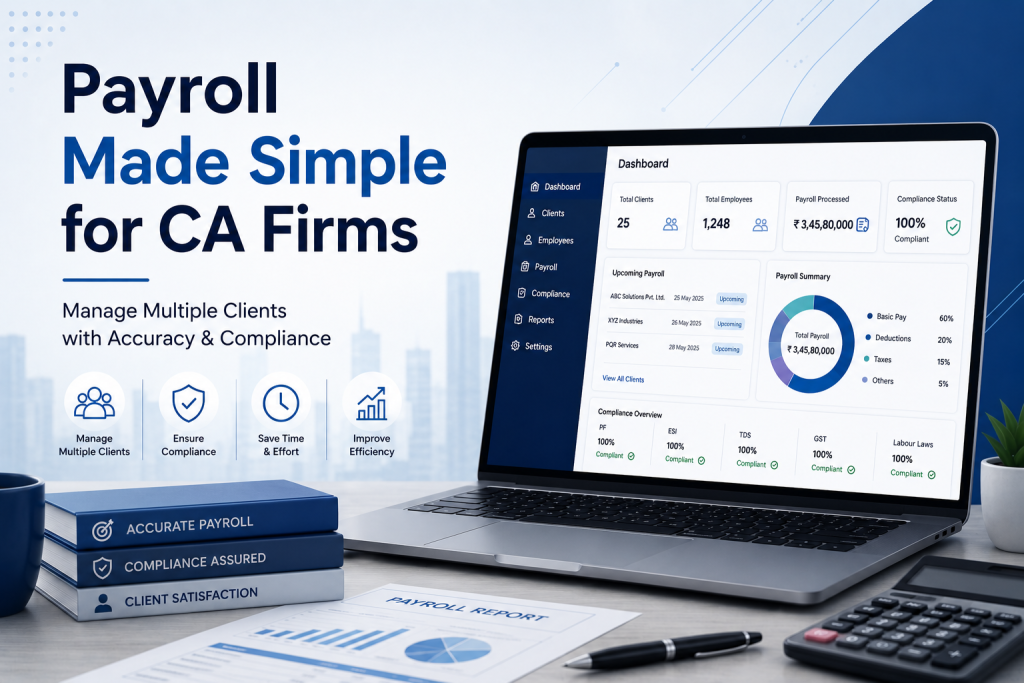
In today’s fast‑paced financial landscape, Chartered Accountant (CA) firms are no longer limited to bookkeeping and tax filing. They are increasingly becoming strategic partners for businesses, offering end‑to‑end financial solutions. One of the most critical services in this spectrum is Payroll Management. For CA firms handling multiple clients across industries, a robust Payroll Management System is not just a convenience, it is a necessity. Why Payroll Management Matters for CA Firms Payroll is more than just salary disbursement. It involves compliance with labor laws, tax regulations, provident fund contributions, gratuity, and employee benefits. Payroll errors can lead to penalties, dissatisfied employees, and reputational damage. For CA firms managing diverse clients, manual processes often result in inefficiencies, duplication of work, and compliance risks. This is where a Payroll Management System for CA firms becomes a game‑changer. Key Benefits of a Payroll Management System 1. Centralized Client Handling A Payroll Management System allows CA firms to manage multiple clients from a single dashboard. Whether it’s a startup with 10 employees or a large enterprise with 500, the system ensures smooth payroll processing without confusion or overlap. 2. Accuracy and Compliance Automated payroll ensures accurate calculations of salaries, deductions, and taxes. Built‑in compliance features help CA firms stay updated with Income Tax, GST, PF, ESI, and labor law regulations, reducing the risk of penalties. 3. Time Efficiency Manual payroll processing is time‑consuming. Automation reduces repetitive tasks, freeing up CA professionals to focus on advisory services, audits, and client growth strategies. 4. Data Security Payroll involves sensitive employee data. A secure Payroll Management System ensures confidentiality through encryption and controlled access, building trust with clients. 5. Scalability As CA firms onboard more clients, the system scales effortlessly. It can handle multiple payroll cycles, diverse pay structures, and industry‑specific requirements without additional overhead. Features CA Firms Should Look For When choosing a Payroll Management System for multiple clients, CA firms should prioritize: Impact on Client Relationships A well‑implemented Payroll Management System enhances client satisfaction. Businesses rely on CA firms not only for compliance but also for strategic insights. By ensuring timely and error‑free payroll, CA firms strengthen their credibility and open doors for cross‑selling services such as tax planning, financial advisory, and audit support. Conclusion For CA firms managing multiple clients, adopting a Payroll Management System is no longer optional—it is essential. It streamlines operations, ensures compliance, saves time, and builds stronger client relationships. In an era where efficiency and trust define success, payroll automation positions CA firms as forward‑thinking partners ready to meet the evolving needs of businesses.
ITR-2 AY 2026-27: New Changes, Eligibility, Deadlines, and Filing Process
The Income Tax Department has notified ITR-2 for Assessment Year (AY) 2026-27, introducing important changes that taxpayers must be aware of. This form is applicable to individuals and Hindu Undivided Families (HUFs) who do not have income from business or profession but may have income from salary, capital gains, multiple house properties, or foreign assets. What is ITR-2? ITR-2 is an income tax return form designed for individuals and HUFs who earn income from sources other than business or profession. It covers salary, pension, capital gains, multiple house properties, foreign assets, and other sources such as dividends or interest. Who Can File ITR-2 for AY 2026-27? Individuals and HUFs can file ITR-2 if they fall under the following categories: Who Cannot File ITR-2? Taxpayers with income from business or profession, including freelancers, consultants, proprietors, or those under presumptive taxation (Sections 44AD, 44ADA, 44AE), must file ITR-3 instead. What Are the New Changes in ITR-2 for AY 2026-27? The form has been updated with several changes: What Documents Are Required? To file ITR-2, taxpayers should keep ready: How to File ITR-2 Online? The filing process is straightforward: What Are the Deadlines? What Are the Risks of Late Filing? Late filing can lead to: Conclusion ITR-2 for AY 2026-27 is crucial for salaried taxpayers, NRIs, and investors with complex income structures. With revised capital gains rules and stricter disclosure requirements, taxpayers must reconcile AIS, Form 26AS, broker statements, and deduction proofs before filing to avoid notices and delays.
Income Tax Act, 2025: Carry forward of losses from Income Tax Act, 1961!
📌 Introduction With the repeal of the Income Tax Act, 1961 and the commencement of the Income Tax Act, 2025 from April 1, 2026, taxpayers have raised concerns about the treatment of past losses and deductions. Losses are crucial in tax planning, as they can reduce future tax liabilities when carried forward or set off. The FAQs released by the Income Tax Department provide detailed guidance on how these transitional provisions will work. This blog explains the FAQs in detail, offering clarity on business losses, capital losses, house property losses, deductions, exemptions, and transitional rules. 🔑 Key Highlights from the FAQs 1. Continuity of Losses 2. Preservation of Nature 3. Belated Returns 4. Restrictions on Undisclosed Income 5. Deductions & Exemptions 6. Violations of Conditions 7. Capital Gains Account Scheme 8. Multi-Year Deductions 9. Unabsorbed Depreciation 📊 Practical Implications for Taxpayers ✅ Conclusion The FAQs provide much-needed clarity on how losses and deductions transition into the new regime. The Income Tax Act, 2025 respects continuity but enforces compliance—losses and deductions remain valid only if they were properly claimed under the old Act. For taxpayers, this means: This ensures a smoother transition while safeguarding the integrity of the tax system.
ITR 1-4 Changes AY 2026-27
ITR 1–4 Updates for FY 2025-26 (AY 2026-27): Key Changes for Individuals & HUFs The Central Board of Direct Taxes (CBDT) has rolled out significant revisions to the Income Tax Return (ITR) forms for AY 2026-27. These updates go beyond cosmetic tweaks—they introduce deeper compliance requirements, broaden disclosure norms, and align with evolving tax laws. Let’s break down the changes in ITR 1, ITR 2, ITR 3, and ITR 4, with clear explanations to help taxpayers and professionals navigate the new landscape. — 🏠 ITR 1 (Sahaj) Designed for salaried individuals and pensioners, ITR 1 has traditionally been the simplest form. For FY 2025-26, however, it has been expanded: · Secondary Contact Information Taxpayers must now provide a secondary address, mobile number, and email ID. This ensures better communication and helps track multiple residences. · Representative Assessee Disclosure If the return is filed by a representative (e.g., for minors, deceased, or incapacitated taxpayers), their details—name, email, and phone number—must be reported. · Two House Properties Allowed Unlike earlier years, taxpayers can now declare up to two house properties in ITR 1. · Detailed Property Reporting Full disclosure is required, including property address, tenant details (PAN/Aadhaar if TDS is claimed), housing loan interest, and co-ownership share. — 📈 ITR 2 ITR 2 applies to individuals and HUFs without business or professional income. Key changes include: · Capital Gains Schedule Simplified Outdated questions and tax rates (like 111A–15%, 112A–10%, LTCG at 10%/20%) have been removed, leaving only current applicable rates. · New Section for Non-Residents Section 115A(1)(a)(iiaa) introduced: o Covers specific interest income under section 194LC(1). o Tax rate fixed at 9%. · Enhanced Deduction Reporting o 80G (Donations): Transaction reference numbers and IFSC codes must be provided. o 80GGC (Political Contributions): Name and PAN of the political party must be disclosed. — 💼 ITR 3 For individuals and HUFs with business or professional income, ITR 3 has seen the most extensive changes: · MSME Act Compliance Interest disallowable under section 23 of the MSME Act must be reported separately, ensuring adherence to payment timelines. · Business/Profession Updates o Section 44BBD added for presumptive taxation of foreign companies providing services related to mineral oil exploration (10% of gross receipts). · Tax Audit Simplification Questions on audit applicability have been streamlined. · F&O Transactions Turnover and income from Futures & Options must be disclosed separately. · Profit & Loss Account Enhancements Presumptive income under sections 44B, 44BB, 44BBA, 44BBC, 44BBD must be shown distinctly. Income credited but not taxable must also be reported. · Expanded Deductions More disability categories under 80DD & 80U; Sikkim added under 80IE for tax holiday benefits. · Income from Firms Interest and remuneration received from firms must be separately disclosed. — 📊 ITR 4 (Sugam) ITR 4, meant for presumptive taxpayers under sections 44AD, 44ADA, or 44AE, has been refined: · Financial Particulars Investments must now be reported separately in the financial details section. · Tax Regime Switching Questions updated to capture cases where taxpayers opt in and out of the new regime (via Form 10IEA) multiple times. — ✨ Key Highlights · ITR 1: Two house properties allowed, with detailed tenant and loan disclosures. · ITR 2: Simplified capital gains, new non-resident income section, stricter donation reporting. · ITR 3: MSME Act compliance, presumptive taxation for foreign service providers, F&O segregation, expanded deductions. · ITR 4: Separate investment reporting and refined regime-switching disclosures. — 📌 Conclusion The revised ITR forms for AY 2026-27 emphasize transparency, accountability, and stricter compliance. Taxpayers must prepare for more detailed disclosures, while professionals need to exercise greater diligence in verifying documents and ensuring accuracy. Even the “simpler” forms now demand comprehensive reporting, underscoring the government’s push toward a more robust tax ecosystem.
Managing Multiple Clients’ ITR, GST, and TDS Filings in the New Financial Year Using Sinewave Cloud
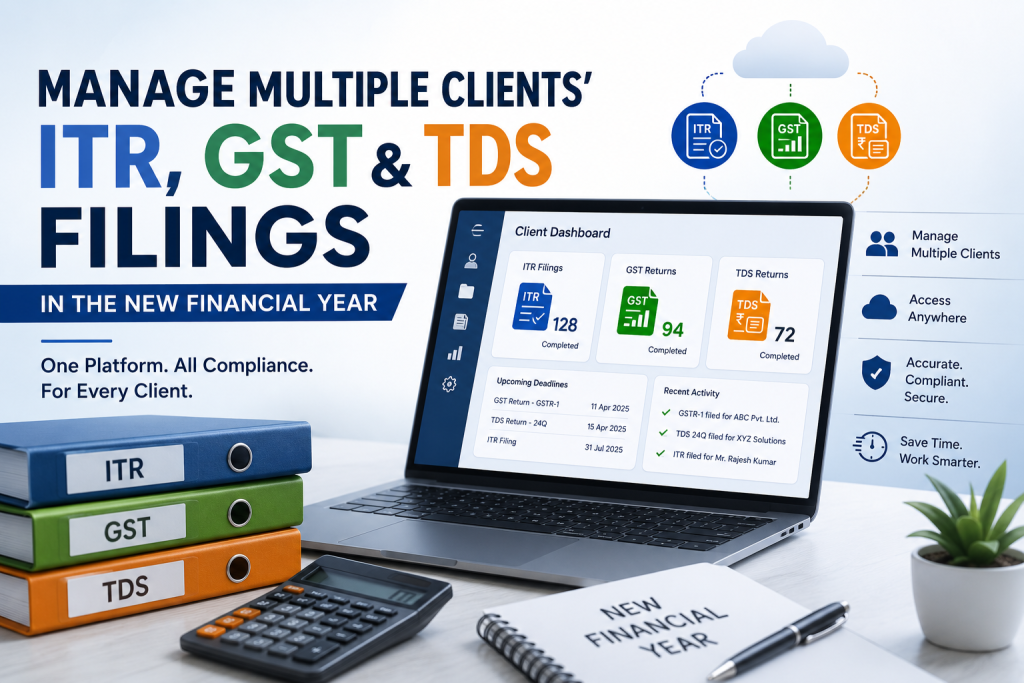
With the onset of the new fiscal year, chartered accountants and other tax professionals are once again faced with the task of filing ITR, GST, and TDS for several clients at once. As the compliance deadline gets tougher each year and penalties for non-compliance increase, there is an urgent need for efficient software. Sinewave Cloud is an ideal solution, providing dedicated software for the three types of taxes mentioned above. Why Cloud-Based Tax Management Matters The traditional form of desktop software faces difficulties in scalability, updates, and multi-client support. On the other hand, the tax management software India through the use of cloud ensures: Updates that are synchronised with the requirements of the government. Access from anywhere, making it possible to conduct work remotely. Centralised dashboards for managing multiple clients at once. For those individuals dealing with many clients, such software as Sinewave Cloud is ideal. GST Filing Made Easy Compliance in terms of GST is one of the hardest to achieve in Indian tax system. This is because it involves many processes, such as reconciliation, return filing, and invoicing, which make room for mistakes. Sinewave provides you with GST return filing software India. Key features include: When comparing different alternatives, it is evident that Sinewave emerges as the Best GST software India because it offers an excellent choice in comparison to other options, such as GST software vs Tally. Notably, it provides a GST software demo India for people to try before purchase. TDS Filing Simplified TDS compliance requires precision—errors in challan matching or PAN verification can lead to notices and penalties. Sinewave’s TDS return filing software India is designed to eliminate these risks. Highlights include: Integrated ITR Filing Apart from GST and TDS, Sinewave Cloud offers solutions for business tax software India in terms of its ITR services. The online GST software India and online TDS software India offered by Sinewave Cloud interface seamlessly with its ITR module, enabling professionals to handle all the compliance needs through a single platform. Benefits for CA Firms and Agencies Efficiency is key for both chartered accountants and agencies. Features such as GST software with invoicing, GST software with reconciliation, and easy GST software are among those featured in Sinewave’s GST software for Chartered Accountants package. Both agencies and chartered accountants need efficiency. Multi-client capable, Sinewave provides agencies with their GST software for chartered accountants and professional TDS software . Features such as GST software with invoicing, GST software with reconciliation and easy GST return filing software halp make the processes easy. The same goes for TDS software. Easy TDS return filing software India and error-free TDS filing software India can make compliance effortless. For agencies that want to maximise the benefits of Sinewave’s software packages, the company provides Best TDS software for CA comparison and demo GST software India packages. Why Choose Sinewave Cloud? Conclusion Handling the GST filing requirements for many clients in the new fiscal year need not be a cumbersome process anymore. With Sinewave Cloud, you can use the best GST billing software India, GSTR software, and bulk filing TDS software, all included in one package. Irrespective of whether you belong to any CA firm, agency, or individual entity, Sinewave’s service offer you the best GST software and the best TDS software for CA in India.
What Are the Benefits of Filing ITR on Time in India?

Benefits of Filing Income Tax Returns on Time Filing your Income Tax Return (ITR) on time is more than just a legal responsibility — it is an important financial habit that can benefit individuals, businesses, and professionals in several ways. With the growing adoption of digital solutions and advanced ITR filing software, the process has become simpler, faster, and more accurate than ever before. Whether you are a salaried employee, freelancer, business owner, or tax consultant, timely income tax filing helps you stay financially secure and compliant. 1. Avoid Penalties and Legal Issues One of the biggest advantages of filing your ITR on time is avoiding late filing penalties and legal complications. Missing the due date may result in penalties under the Income Tax Act, along with additional interest on unpaid taxes. Timely filing ensures that you stay compliant with tax regulations and avoid unnecessary stress during tax season. Using reliable income tax filing software can further reduce the risk of errors and missed deadlines. 2. Faster Tax Refund Processing If you are eligible for a tax refund, filing your return early helps you receive the refund much faster. Delayed filing often means delayed processing. Modern ITR filing software automates calculations, validates information, and speeds up the filing process, ensuring your return reaches the tax department without errors. This improves refund processing time significantly. 3. Easier Loan and Visa Approvals Banks and financial institutions often ask for ITR documents while processing home loans, car loans, business loans, or credit card applications. Regularly filed income tax returns act as proof of income and financial stability. Similarly, many embassies require ITR acknowledgements during visa applications. Filing your returns on time builds credibility and strengthens your financial profile. 4. Carry Forward Business or Capital Losses Another important benefit of timely filing is the ability to carry forward certain losses, such as business losses or capital losses, to future financial years. These losses can help reduce future tax liabilities. However, this benefit is usually available only if the ITR is filed within the prescribed due date. Missing the deadline could mean losing valuable tax-saving opportunities. 5. Better Financial Planning Filing income tax returns regularly helps individuals and businesses maintain proper financial records. It provides a clear picture of income, expenses, investments, and taxes paid throughout the year. Businesses and tax professionals increasingly depend on cloud-based income tax filing software for better data management, automated compliance, and accurate reporting. This improves overall financial planning and decision-making. 6. Reduces Stress During Tax Season Last-minute tax filing often leads to confusion, missing documents, and calculation errors. Filing early allows enough time to organize documents, verify deductions, and correct mistakes if required. Advanced ITR filing software simplifies the entire process through automation, smart validation, and seamless return preparation. It helps tax professionals and businesses manage multiple filings efficiently while reducing workload and stress. 7. Enhances Compliance and Accuracy Manual tax filing increases the chances of errors in calculations, PAN details, deductions, and bank information. Incorrect filing can lead to notices or delayed processing. Using professional income tax filing software ensures higher accuracy, automated tax computation, and real-time validation checks. It improves compliance and minimizes filing risks. Conclusion Timely ITR filing offers several financial and legal advantages, from avoiding penalties to improving financial credibility. With the help of modern ITR filing software and income tax filing software, taxpayers and professionals can simplify compliance, save time, and ensure error-free filing. As tax regulations continue to evolve, adopting smart tax technology solutions can make the filing process more efficient, secure, and stress-free for everyone. [/et_pb_text][/et_pb_column][/et_pb_row][/et_pb_section]
TDS Rates for FY 2026-27
✨ Introduction Tax Deducted at Source (TDS) is a key compliance mechanism under the Income Tax Act, ensuring tax collection at the point of income generation. For FY 2026-27 (Tax Year 2026-27), effective from 1st April 2026, the Income Tax Act 2025 (New) consolidates most provisions into Section 393, simplifying compliance while retaining familiar rates. This guide provides a detailed table of applicable TDS rates for payments to residents and non-residents, along with compliance notes. 🏠 Table – For Payment to Residents Sr No. Old Act Section New Act Section Ref Serial No. Nature of Payment Applicable Payer Threshold Limit TDS Rate 1 192 392 N/A Salary Any employer Basic exemption limits Slab rates 2 194H 393 1 Commission or brokerage Any person ₹20,000 2% 3 194I(a) 393 2 Rent – Land/Building/Furniture Any person other than Individual/HUF ₹50,000 per month 10% 4 194I(b) 393 2 Rent – Plant/Machinery/Equipment Any person other than Individual/HUF ₹50,000 per month 2% 5 194IB 393 2 Rent by Individual/HUF Individual/HUF ₹50,000 per month 2% 6 194IA 393 3 Transfer of immovable property (other than agricultural land) Any person ₹50,00,000 (stamp duty value or consideration, whichever higher) 1% 7 194IA 393 3 Capital gain on development agreement (Sec 67(14)) Any person Nil 10% 8 194IA 393 3 Compensation/enhanced consideration Any person ₹5,00,000 10% 9 194K 393 4 Income from mutual fund units/specified company units Any person ₹10,000 10% 10 194K 393 4 Distributed income Business Trust Nil 10% 11 194K 393 4 Income from investment fund units Investment Fund Nil 10% 12 194K 393 4 Income from securitisation trust Securitisation Trust Nil 10% 13 194A 393 5 Interest (other than securities) Specified persons ₹50,000 (banks/co-op), ₹1,00,000 (senior citizens), ₹10,000 (others) 10% 14 194C 393 6 Payments to contractors Specified persons ₹30,000 single / ₹1,00,000 aggregate 1% / 2% 15 194J(a) 393 6 Professional services Specified persons ₹50,000 10% 16 194J(b) 393 6 Technical services Specified persons ₹50,000 2% 17 194 393 7 Dividend Any person Nil 10% 18 194Q 393 8 Purchase of goods Buyer turnover > ₹10 Cr ₹50,00,000 0.10% 19 194DA 393 8 Payment from life insurance policy Any person ₹1,00,000 2% 20 194P 393 8 Senior citizen income (after deductions/rebate) Specified bank Basic exemption limits Slab rates 21 194R 393 8 Business/professional perquisites Specified person ₹20,000 10% 22 194O 393 8 E-commerce transactions E-commerce operator Nil 0.10% 23 194S 393 8 Transfer of virtual digital assets Any person Nil 1% 🌍 Table – For Payment to Non-Residents Sl No. Nature of Income Payee Payer Rate 1 Income of non-resident sportsman/entertainer Non-resident Any person 20% 2 Interest on foreign currency loans/bonds (pre-2023) Non-resident/foreign company Indian company/trust 5% 3 Interest on rupee denominated bonds (pre-2023) Non-resident/foreign company Indian company/trust 5% 4 Interest on IFSC listed bonds Non-resident/foreign company Indian company/trust 4% (till June 2023), 9% (after July 2023) 5 Interest from infrastructure debt fund Non-resident/foreign company Debt fund 5% 6 Distributed income from business trust Non-resident unit holder Business trust 5%–10% 7 Mutual fund units/specified company units Non-resident Any person 20% (subject to DTAA) 8 Offshore fund units Offshore fund Any person 10% 9 LTCG on offshore fund units Offshore fund Any person 12.5% 10 GDRs/bonds – Interest/dividends Non-resident Any person 10% 11 GDRs/bonds – LTCG Non-resident Any person 12.5% 12 Securities income (FII) FII Any person 20% (subject to DTAA) 13 Securities income (specified fund) Specified fund Any person 10% 14 Other interest/sums (not salaries) Non-resident/foreign company Any person Rates in force 📌 Notes ✅ Conclusion The FY 2026-27 TDS framework consolidates provisions under the Income Tax Act 2025, streamlining compliance while tightening rules around dividends, VDAs, and e-commerce transactions. With reduced thresholds and expanded coverage, taxpayers must ensure timely deduction and deposit of TDS to avoid penalties. This structured approach makes compliance easier for businesses, professionals, and individuals while aligning taxation with evolving financial and digital transactions.
CBDT Sets 31st March 2026 as Last Date for TDS/TCS Correction Statements (FY 2018–19 to 2023–24)
Introduction Tax compliance in India has undergone significant transformation over the past decade, with digitization and stricter monitoring ensuring greater transparency in reporting. One of the most critical aspects of compliance is the accurate filing of Tax Deducted at Source (TDS) and Tax Collected at Source (TCS) statements. These statements form the backbone of the tax credit system, directly impacting taxpayers’ ability to claim deductions and refunds. Recognizing that errors in these filings can cause long-term complications, the Central Board of Direct Taxes (CBDT) has provided a final window for corrections. The CBDT has announced that 31st March 2026 will be the cut-off date for filing correction statements for financial years 2018–19 to 2023–24. After this date, no further corrections will be permitted. This announcement is a wake-up call for deductors and collectors to review their past filings and ensure accuracy before the deadline. — Understanding TDS/TCS Correction Statements TDS and TCS are mechanisms designed to collect tax at the source of income. Deductors (employers, businesses, or institutions) and collectors (entities responsible for collecting tax at source) are required to file quarterly statements detailing the tax deducted or collected. However, errors often creep in due to: · Incorrect PAN entries of deductees. · Wrong challan details. · Mismatches in amounts deducted or collected. · Technical errors during uploading on the TRACES portal. Correction statements allow deductors and collectors to rectify these mistakes. Once filed, the corrected data flows into the taxpayer’s Form 26AS and Annual Information Statement (AIS), ensuring proper credit of taxes. — Why the 31st March 2026 Deadline Matters The CBDT’s decision to fix a final deadline has far-reaching implications: · Closure of Past Years: Financial years 2018–19 to 2023–24 cover six years of filings. This window is the last chance to clean up errors in these years. · Impact on Taxpayers: If corrections are not filed, taxpayers may face mismatches in their records, leading to denial of credit or delays in refunds. · Compliance Risk: Deductors who fail to correct errors may face queries during assessments or audits, as mismatched data often triggers scrutiny. · System Efficiency: By closing corrections after March 2026, the Income Tax Department aims to streamline records and reduce the burden of managing legacy data. — Common Errors That Need Correction Before the deadline, deductors and collectors should carefully review their filings for the following issues: · PAN Errors: Incorrect or invalid PAN entries prevent tax credits from reflecting in the deductee’s account. · Challan Mismatches: Wrong challan numbers or amounts can lead to discrepancies in tax payment records. · Deductee Details: Errors in names, addresses, or amounts deducted can cause mismatches in AIS. · Quarterly Statement Errors: Missing or wrongly reported transactions in quarterly TDS/TCS returns. — Action Plan for Deductors and Collectors To ensure compliance before the deadline, organizations should adopt a structured approach: 1. Review Past Statements: Conduct a thorough audit of TDS/TCS filings for FY 2018–19 to FY 2023–24. 2. Identify Errors: Use reconciliation tools to compare filed data with challans, books of accounts, and deductee records. 3. File Corrections Promptly: Submit correction statements through the TRACES portal well before the deadline. 4. Maintain Documentation: Keep records of corrections filed, acknowledgments, and supporting documents for audit purposes. 5. Communicate with Deductees: Inform employees, vendors, or clients if corrections affect their tax credits. — Practical Guidance for Smooth Compliance · Avoid Last-Minute Rush: The TRACES portal may experience heavy traffic closer to the deadline. Filing early reduces the risk of technical glitches. · Seek Professional Help: Chartered Accountants (CAs) and tax consultants can review filings to ensure accuracy. · Leverage Technology: Use compliance software to identify mismatches and generate correction files. · Stay Updated: Monitor CBDT notifications for any clarifications or procedural changes. — Implications for Taxpayers While the responsibility of filing correction statements lies with deductors and collectors, taxpayers must remain vigilant: · Check Form 26AS and AIS: Ensure that tax credits are correctly reflected. · Follow Up with Deductors: If discrepancies exist, request the deductor to file corrections before the deadline. · Plan Refunds Accordingly: Incorrect data may delay refunds or lead to disputes during filing. — Broader Compliance Perspective This move by the CBDT reflects a broader trend in tax administration: · Data Accuracy: The government is emphasizing accurate reporting to reduce disputes. · Digital Integration: With AIS and pre-filled returns, errors in TDS/TCS data directly affect taxpayers. · Finality of Records: By setting a cut-off, the department ensures closure of past years, allowing focus on current and future compliance. — Conclusion The 31st March 2026 deadline is not just a procedural announcement, it is a decisive step towards ensuring accuracy and finality in tax records. Deductors and collectors must treat this as a compliance priority, acting well in advance to avoid last-minute hurdles. Timely corrections will safeguard deductors from penalties and scrutiny while ensuring taxpayers receive accurate credit for taxes paid. For businesses, professionals, and individuals alike, this is the last opportunity to clean up six years of data. By acting now, stakeholders can avoid complications, build trust in compliance systems, and contribute to a smoother tax administration process.