Managing Multiple Clients’ ITR, GST, and TDS Filings in the New Financial Year Using Sinewave Cloud
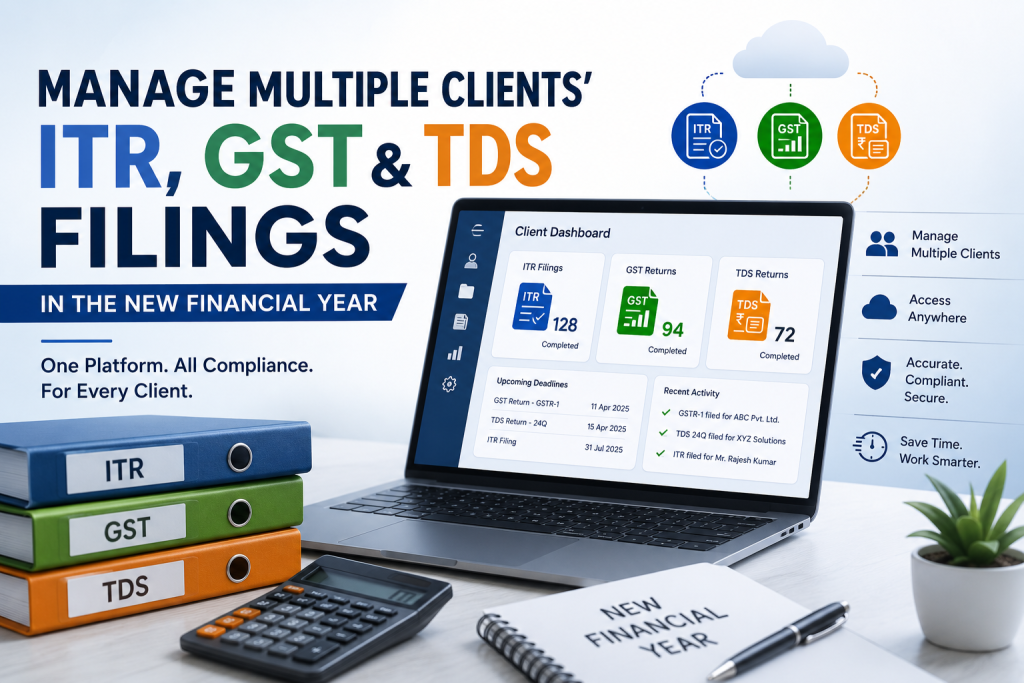
With the onset of the new fiscal year, chartered accountants and other tax professionals are once again faced with the task of filing ITR, GST, and TDS for several clients at once. As the compliance deadline gets tougher each year and penalties for non-compliance increase, there is an urgent need for efficient software. Sinewave Cloud is an ideal solution, providing dedicated software for the three types of taxes mentioned above. Why Cloud-Based Tax Management Matters The traditional form of desktop software faces difficulties in scalability, updates, and multi-client support. On the other hand, the tax management software India through the use of cloud ensures: Updates that are synchronised with the requirements of the government. Access from anywhere, making it possible to conduct work remotely. Centralised dashboards for managing multiple clients at once. For those individuals dealing with many clients, such software as Sinewave Cloud is ideal. GST Filing Made Easy Compliance in terms of GST is one of the hardest to achieve in Indian tax system. This is because it involves many processes, such as reconciliation, return filing, and invoicing, which make room for mistakes. Sinewave provides you with GST return filing software India. Key features include: When comparing different alternatives, it is evident that Sinewave emerges as the Best GST software India because it offers an excellent choice in comparison to other options, such as GST software vs Tally. Notably, it provides a GST software demo India for people to try before purchase. TDS Filing Simplified TDS compliance requires precision—errors in challan matching or PAN verification can lead to notices and penalties. Sinewave’s TDS return filing software India is designed to eliminate these risks. Highlights include: Integrated ITR Filing Apart from GST and TDS, Sinewave Cloud offers solutions for business tax software India in terms of its ITR services. The online GST software India and online TDS software India offered by Sinewave Cloud interface seamlessly with its ITR module, enabling professionals to handle all the compliance needs through a single platform. Benefits for CA Firms and Agencies Efficiency is key for both chartered accountants and agencies. Features such as GST software with invoicing, GST software with reconciliation, and easy GST software are among those featured in Sinewave’s GST software for Chartered Accountants package. Both agencies and chartered accountants need efficiency. Multi-client capable, Sinewave provides agencies with their GST software for chartered accountants and professional TDS software . Features such as GST software with invoicing, GST software with reconciliation and easy GST return filing software halp make the processes easy. The same goes for TDS software. Easy TDS return filing software India and error-free TDS filing software India can make compliance effortless. For agencies that want to maximise the benefits of Sinewave’s software packages, the company provides Best TDS software for CA comparison and demo GST software India packages. Why Choose Sinewave Cloud? Conclusion Handling the GST filing requirements for many clients in the new fiscal year need not be a cumbersome process anymore. With Sinewave Cloud, you can use the best GST billing software India, GSTR software, and bulk filing TDS software, all included in one package. Irrespective of whether you belong to any CA firm, agency, or individual entity, Sinewave’s service offer you the best GST software and the best TDS software for CA in India.
Concept of Input Tax credit-PART I
Under the Indirect taxes mechanism, the taxes are levied at every stage of value addition. This is applicable in case of supply of goods as well as services. Thus it is important to understand that tax and the value addition will be always coupled together. Value addition continues till the time the goods or services reach the ultimate consumer. The ultimately generated value of goods or services is going to be a cost to the consumer. This cost will be a composition of (Value generated + Tax levied at each stage). Now if the tax at every stage is absorbed as a part of value of goods or services, there would be a case of “cascading effect of tax” (levy of tax on already levied tax). As a result of this the ultimate consumer would be the one who would suffer the most. As consumer would be liable to bear the entire load of taxes along with the value of goods. This has been a known issue under the Indirect tax structure in our country. Therefore, even in the Pre-GST regime, there were certain counter measures undertaken to deal with the problem of hefty pricing in the hands of consumers. Under the Central Excise and Service tax, there were “Modvat credit” / “Cenvat credit” provisions whereby the concept of “Input tax credit” was incorporated. Likewise under the VAT provisions, the concept of Input VAT credit was incorporated. Firstly, let us try to understand, what is the meaning of “Input tax credit”? Input tax credit means, the credit of taxes paid on purchase of goods, services or capital goods. The tax component on the purchase of goods or services will not form a part of cost of purchases, but will be recorded as a pre-paid tax. This pre-paid tax will be utilized to pay the liability of tax on outward supply of goods or services. In order to understand this, let us look at the under mentioned illustration. Determination of availability of Input tax credit: We have considered two scenarios in the below mentioned tables. In the Case-1, we are assuming that there is “No Input tax credit available”. In this case, one can observe that the Input tax is becoming a part of “Total cost of purchase” which is fondly known as “cascading effect of taxes”. In the Case-2, the Input tax is not becoming part of cost of purchase. As a result of this there is no levy of tax on tax unlike under Case-1. In Case-2, even if the profits are assumed to be on absolute terms like Case-1, still it can be observed that with the elimination of “cascading effect”, the “Consumers Purchase price” is less in Case-2 as compared to Case-1. Thus, it is pertinent to note that the availability of Input tax credit reduces the consumer purchase price. Even when the profit amount was kept same in absolute terms in Case-2, still the buyer will be benefitted. Thus under the Input tax credit there are also economic benefits such as “reduction in consumer price”. Reduction in overall prices also would contribute towards reducing “Inflation”. Input tax credit under GST Under the Pre-GST regime, although Input tax credit was available, there was an issue as far as cross utilization of taxes across the Excise/Service tax with VAT laws. The same was not available under the cross utilization basis. Under the GST regime, availability of “seamless credit” is one of the prime objectives. Basis this let us now analyze the provisions of Section 16, 17, 18 and 19 of the CGST Act 2017. Eligibility to claim Input tax credit Section 16: (1) Every registered person shall, subject to such conditions and restrictions as may be prescribed and in the manner specified in section 49, be entitled to take credit of input tax charged on any supply of goods or services or both to him which are used or intended to be used in the course or furtherance of his business and the said amount shall be credited to the electronic credit ledger of such person. The provisions of this section provide for a generic eligibility for availing input tax credit. Based on the above, it can be noted that “Every registered person “, is entitled to claim Input tax credit in respect of goods and or services, which are used or intended to be used in the course or furtherance of business. Thus reading the provisions of this section, one would conclude that the Input tax credit in respect of anything and everything ie (goods or services) which are procured can be made eligible for claiming credit if the same has been used in the course or furtherance of business. However, it is not so the case. Thus let us further take a look at the conditions. (2) Notwithstanding anything contained in this section, no registered person shall be entitled to the credit of any input tax in respect of any supply of goods or services or both to him unless, The under mentioned conditions are to be followed compulsorily. As per the sub section 2 of Section 16 of the CGST Act 2017 the under mentioned conditions are (a) he is in possession of a tax invoice or debit note issued by a supplier registered under this Act, or such other tax paying documents as may be prescribed; In order to avail Input tax credit in respect of goods or services or both, it is mandatory to have the physical possession of Invoice or any other tax paying document. Where it is also important to note that the invoices or the tax paying documents should be as per the specifications mentioned down under the provisions of Section 31 of the CGST Act and the rules in respect of the same. (b) he has received the goods or services or both. The physical possession of goods and the actual receipt of services are the key factors. This is to ensure that the input tax credit is
Impact of GST on Small and Medium Businesses in India
The online platforms like Quora, Reddit and similar other are overflowing with questions like – Do I need a GST number for my small business? Who are liable to register under GST in India? How to register for GST in India? Why we need GST? When Do I need to register for GST? What is the GST bill? What are the documents required for GST registration in India? Will a logistics company be required to take GST (Goods & Services Tax) registration in India? When GST fresh online registration (new business) will be commenced in India? What is the date of registration in GST for service providers in India? When will the GST registration process start in India? Is excise duty included in GST? What is IGST, CGST, SGST? So here are some simple points that will help you if you are a small or medium business owner and looking for information about GST bill and its implementation on and after 1st July 2017. GST (Goods and Service Tax): Is it applicable to your small business? The short answer is ‘Yes’. What is CGST, SGST & IGST? Before introduction of GST, there were different Indirect taxes in India like custom duty, excise duty, service tax, luxury tax, VAT and many more. Some of them was charged by state government and some by central government. When, GST introduced all these Indirect Taxes has been merged in single Goods & Service Tax. Now, GST will be equally divided between State Government and Central Government. The tax portion collected by centre is named as CGST whereas the tax collected by state is named as SGST.GST is the tax based on consumption collected by the state where product or service is consumed and not by the state where it is manufactured. There is a separate tax collected under the name IGST for inter-state sales. When dealer of one state sells the product to dealer of another state, then IGST is collected by the centre. Both the states involved in the trade may not have to deal with each other, but they will be dealing with centre in case of IGST. GST Software will take care of these different tax heads. However, in order to embrace the change, it is important to incorporate appropriate measures for effortless transition. What you should do? It is time to be GST ready to avail the advantages of GST in flawless manner. GST Software will help you accomplish this in the most trusted manner. But, before making any GST Filing & Invoicing Software a part of your business, you may follow the following steps: Update your accounting systems – Earlier taxation system required the payment of VAT (Value Added Tax) at all levels of supply chain, but the new system of taxation under GST requires payment of only destination based tax. In order to incorporate this new tax regime, amendments need to be made in invoice generation, recording of expenses, and purchase order generation. Businesses may be required to claim input credit for the taxes and this may call for invoice details as well. Accounting system must be updated as per this new taxation norms in order to get GST ready. Be ready for the change in economy – GST would bring the welcome change in economy. The tax rates would differ for goods and services. Various tax slabs like 5%, 12%, 18%, and 28% are designated for different goods and services. Know the tax slab for your range of products and services. Earlier the accounting data was tallied half yearly or quarterly, but now this will be done monthly and this will also help in regulating monthly supply with the relevant supply and sales data. Economy will witness a new high once all the processes would be streamlined. Go Digital – The final step to successful GST implementation is to go digital. Many IT companies are coming up with GST Billing Software for small business to make them GST ready without requiring any major efforts and man power. Look for the reliable GST India software that is designed for all the compliances set by the government for this new tax reform. There are many GST software providers in India, but the best GST software would be the one that incorporates all the aspects of this new tax reform. Sinewave Taxbase GSTPro is designed for preparation of GST Returns, filing GST Returns, and also for export/import of crucial data. The software is fairly priced and offers utmost accounting support to small and medium businesses in India. It is reliable and efficient enough to take any business smoothly through this GST transition.