
ITR 1-4 Changes AY 2026-27
ITR 1–4 Updates for FY 2025-26 (AY 2026-27): Key Changes for Individuals & HUFs The Central Board of Direct Taxes (CBDT) has rolled out significant revisions to the Income Tax Return (ITR) forms for AY 2026-27. These updates go beyond cosmetic tweaks—they introduce deeper compliance requirements, broaden disclosure norms, and align with evolving tax laws. Let’s break down the changes in ITR 1, ITR 2, ITR 3, and ITR 4, with clear explanations to help taxpayers and professionals navigate the new landscape. — 🏠 ITR 1 (Sahaj) Designed for salaried individuals and pensioners, ITR 1 has traditionally been the simplest form. For FY 2025-26, however, it has been expanded: · Secondary Contact Information Taxpayers must now provide a secondary address, mobile number, and email ID. This ensures better communication and helps track multiple residences. · Representative Assessee Disclosure If the return is filed by a representative (e.g., for minors, deceased, or incapacitated taxpayers), their details—name, email, and phone number—must be reported. · Two House Properties Allowed Unlike earlier years, taxpayers can now declare up to two house properties in ITR 1. · Detailed Property Reporting Full disclosure is required, including property address, tenant details (PAN/Aadhaar if TDS is claimed), housing loan interest, and co-ownership share. — 📈 ITR 2 ITR 2 applies to individuals and HUFs without business or professional income. Key changes include: · Capital Gains Schedule Simplified Outdated questions and tax rates (like 111A–15%, 112A–10%, LTCG at 10%/20%) have been removed, leaving only current applicable rates. · New Section for Non-Residents Section 115A(1)(a)(iiaa) introduced: o Covers specific interest income under section 194LC(1). o Tax rate fixed at 9%. · Enhanced Deduction Reporting o 80G (Donations): Transaction reference numbers and IFSC codes must be provided. o 80GGC (Political Contributions): Name and PAN of the political party must be disclosed. — 💼 ITR 3 For individuals and HUFs with business or professional income, ITR 3 has seen the most extensive changes: · MSME Act Compliance Interest disallowable under section 23 of the MSME Act must be reported separately, ensuring adherence to payment timelines. · Business/Profession Updates o Section 44BBD added for presumptive taxation of foreign companies providing services related to mineral oil exploration (10% of gross receipts). · Tax Audit Simplification Questions on audit applicability have been streamlined. · F&O Transactions Turnover and income from Futures & Options must be disclosed separately. · Profit & Loss Account Enhancements Presumptive income under sections 44B, 44BB, 44BBA, 44BBC, 44BBD must be shown distinctly. Income credited but not taxable must also be reported. · Expanded Deductions More disability categories under 80DD & 80U; Sikkim added under 80IE for tax holiday benefits. · Income from Firms Interest and remuneration received from firms must be separately disclosed. — 📊 ITR 4 (Sugam) ITR 4, meant for presumptive taxpayers under sections 44AD, 44ADA, or 44AE, has been refined: · Financial Particulars Investments must now be reported separately in the financial details section. · Tax Regime Switching Questions updated to capture cases where taxpayers opt in and out of the new regime (via Form 10IEA) multiple times. — ✨ Key Highlights · ITR 1: Two house properties allowed, with detailed tenant and loan disclosures. · ITR 2: Simplified capital gains, new non-resident income section, stricter donation reporting. · ITR 3: MSME Act compliance, presumptive taxation for foreign service providers, F&O segregation, expanded deductions. · ITR 4: Separate investment reporting and refined regime-switching disclosures. — 📌 Conclusion The revised ITR forms for AY 2026-27 emphasize transparency, accountability, and stricter compliance. Taxpayers must prepare for more detailed disclosures, while professionals need to exercise greater diligence in verifying documents and ensuring accuracy. Even the “simpler” forms now demand comprehensive reporting, underscoring the government’s push toward a more robust tax ecosystem.
Managing Multiple Clients’ ITR, GST, and TDS Filings in the New Financial Year Using Sinewave Cloud
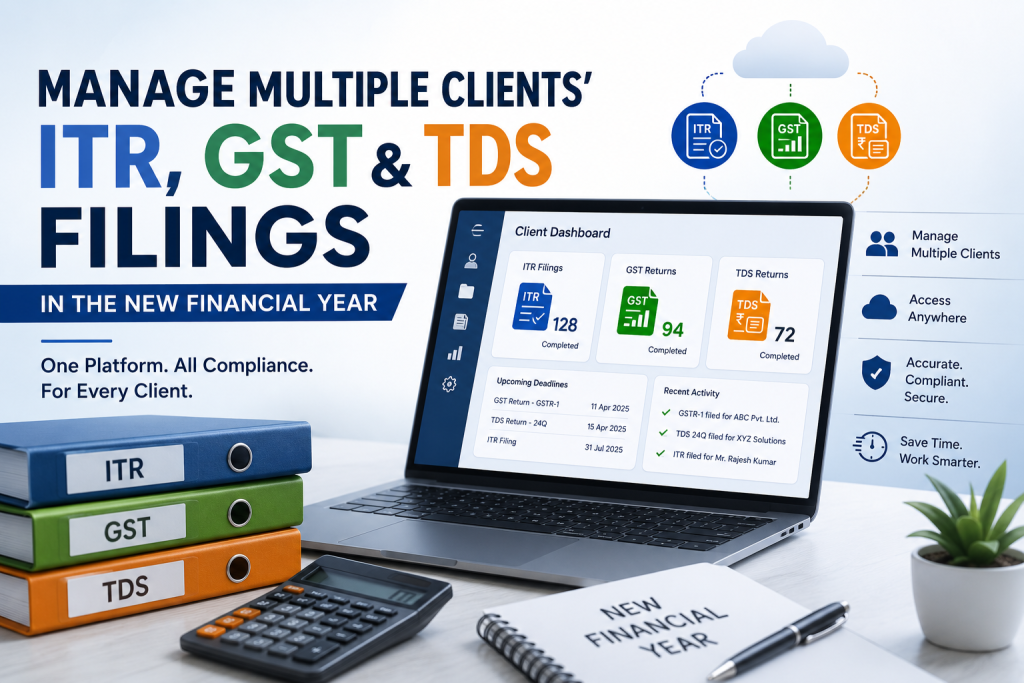
With the onset of the new fiscal year, chartered accountants and other tax professionals are once again faced with the task of filing ITR, GST, and TDS for several clients at once. As the compliance deadline gets tougher each year and penalties for non-compliance increase, there is an urgent need for efficient software. Sinewave Cloud is an ideal solution, providing dedicated software for the three types of taxes mentioned above. Why Cloud-Based Tax Management Matters The traditional form of desktop software faces difficulties in scalability, updates, and multi-client support. On the other hand, the tax management software India through the use of cloud ensures: Updates that are synchronised with the requirements of the government. Access from anywhere, making it possible to conduct work remotely. Centralised dashboards for managing multiple clients at once. For those individuals dealing with many clients, such software as Sinewave Cloud is ideal. GST Filing Made Easy Compliance in terms of GST is one of the hardest to achieve in Indian tax system. This is because it involves many processes, such as reconciliation, return filing, and invoicing, which make room for mistakes. Sinewave provides you with GST return filing software India. Key features include: When comparing different alternatives, it is evident that Sinewave emerges as the Best GST software India because it offers an excellent choice in comparison to other options, such as GST software vs Tally. Notably, it provides a GST software demo India for people to try before purchase. TDS Filing Simplified TDS compliance requires precision—errors in challan matching or PAN verification can lead to notices and penalties. Sinewave’s TDS return filing software India is designed to eliminate these risks. Highlights include: Integrated ITR Filing Apart from GST and TDS, Sinewave Cloud offers solutions for business tax software India in terms of its ITR services. The online GST software India and online TDS software India offered by Sinewave Cloud interface seamlessly with its ITR module, enabling professionals to handle all the compliance needs through a single platform. Benefits for CA Firms and Agencies Efficiency is key for both chartered accountants and agencies. Features such as GST software with invoicing, GST software with reconciliation, and easy GST software are among those featured in Sinewave’s GST software for Chartered Accountants package. Both agencies and chartered accountants need efficiency. Multi-client capable, Sinewave provides agencies with their GST software for chartered accountants and professional TDS software . Features such as GST software with invoicing, GST software with reconciliation and easy GST return filing software halp make the processes easy. The same goes for TDS software. Easy TDS return filing software India and error-free TDS filing software India can make compliance effortless. For agencies that want to maximise the benefits of Sinewave’s software packages, the company provides Best TDS software for CA comparison and demo GST software India packages. Why Choose Sinewave Cloud? Conclusion Handling the GST filing requirements for many clients in the new fiscal year need not be a cumbersome process anymore. With Sinewave Cloud, you can use the best GST billing software India, GSTR software, and bulk filing TDS software, all included in one package. Irrespective of whether you belong to any CA firm, agency, or individual entity, Sinewave’s service offer you the best GST software and the best TDS software for CA in India.